Protect — CrossFit

You Didn't Come
This Far to Stop
at a Ripped Callus.

Guard-Tex prevents hand tears before they happen and covers rips when they do — through pull-ups, toes-to-bar, rope climbs, and barbell work. No adhesive. No pain at removal. Just hands that make it to the end of the WOD.

Scroll

The Rip Is the Symptom. Friction Is the Problem.

Every CrossFit athlete has the moment: you're mid-WOD, deep into a set of kipping pull-ups, and you feel it — the hot spot, then the tear, then the flap of skin hanging from the base of your finger. You've got 20 reps left and the clock is running.

Hand rips happen because of shear force — your body weight rotating around the bar while your callused skin grips the surface. The callus catches, the skin below it doesn't, and the layers separate. It's not about grip strength or hand care routines. It's about the physics of a 175-pound body swinging from a steel bar at high speed.

The standard fixes all have tradeoffs. Grips protect your palms but add a layer between you and the bar — slower transitions, altered kip timing, and that disconnected feeling on muscle-ups. Athletic tape uses adhesive that fails when you chalk up and tears at the skin when you rip it off — sometimes taking the top layer of a fresh wound with it. Callus shaving helps but gets the timing wrong half the time — shave too much and your hands are raw, too little and the callus catches anyway.

The real solution protects the skin's surface without eliminating your connection to the bar. You need a barrier thin enough to preserve feel but tough enough to absorb the shear force that causes tears.

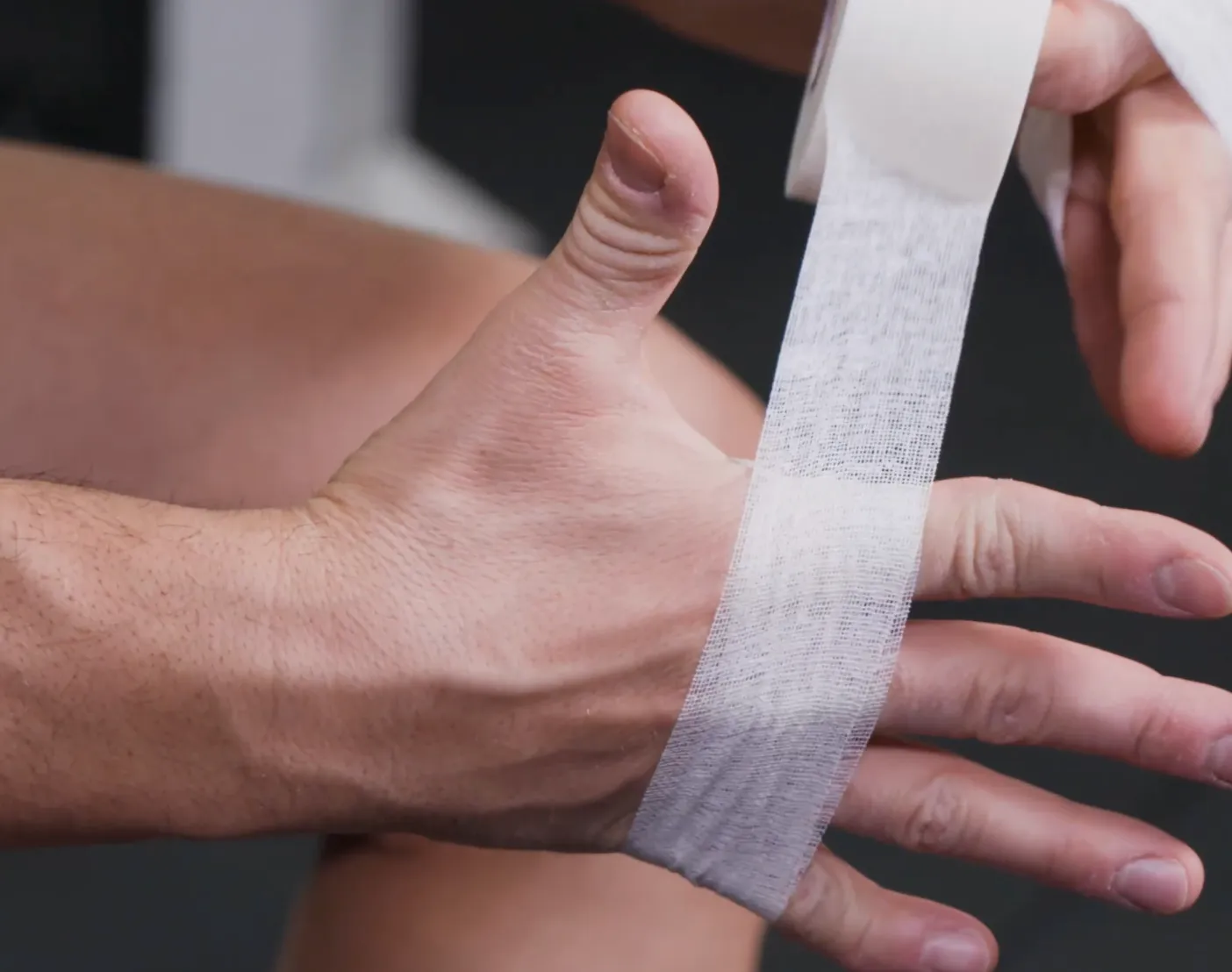
Hands wrapped with Guard-Tex tape for CrossFit training

Self-Adhering Technology

Bonds to itself. Never to your skin.

Guard-Tex uses cohesive gauze — it grips itself, not you. Wrap it on, chalk over it, rip through a WOD, then unwrap without a wince. No adhesive residue. No ripping hair. No pulling at torn skin. The wound underneath stays untouched.

Three Scenarios. One Roll Handles All of Them.

Prevention — before the WOD. If you know the programming includes high-rep pull-ups, T2B, or rope climbs, wrap your hot spots before you start. Two to three layers of Guard-Tex across the callus ridge at the base of fingers 2, 3, and 4. The gauze absorbs the shear force that would otherwise separate your callus from the skin beneath it. You still feel the bar. You still hold chalk. You just don't rip.

Protection — mid-WOD. You tore. It happens. Rip a strip of Guard-Tex, wrap it over the tear in seconds, chalk up, and get back on the bar. Because there's zero adhesive, the tape doesn't touch the wound — it bridges over the exposed skin and bonds to itself on either side. No sting, no stuck fibers, no reason to scale the rest of the workout.

Recovery — after training. Keep a wrap on torn hands after the gym. Guard-Tex lets the wound breathe while protecting it from doorknobs, steering wheels, and handshakes — all the things that make a hand rip miserable for the next 48 hours. When you peel it off, the skin underneath is clean and undisturbed. No adhesive ripping the healing tissue.

"I used to lose two or three training days every month to ripped hands. Now I tape before any high-volume pull-up day and I haven't had a competition-affecting rip in over a year."
— Alicia G., CrossFit competitor, Denver
0
Adhesive Contact
5M+
Rolls Shipped
0
Residue Left
100%
Made in USA

Guard-Tex vs. Everything Else in Your Gym Bag

Guard-Tex Gymnastics Grips Athletic Tape Gloves
Bar feel preserved Thin gauze Reduced Somewhat Bulky
Survives chalk Holds chalk better Adhesive fails
Covers open tears No adhesive on wound Rubs on skin Sticks to wound
Removal pain Zero N/A Pulls hair/skin N/A
Transition speed No change Slower on/off bar No change Slower
Rope climb safe Can catch Peels off Dangerous
Cost per month ~$8 $25–50 $12–20 $20–40

How to Tape Your Hands for CrossFit

Three minutes before the WOD. One roll. No scissors needed — Guard-Tex tears by hand.

1

Find Your Hot Spots

Look at your hands. Where are the calluses thickest? Where did you tear last time? For most athletes, it's the ridge at the base of fingers 2, 3, and 4 — the meaty pad that grips the bar during pull-ups and toes-to-bar. Some rip at the palm center from rope climbs. Those are your target zones.

2

Wrap 2–3 Layers

Tear a strip and wrap it around the affected fingers or across the palm ridge, overlapping each pass by half. Two layers for prevention, three if you're covering an existing tear. Keep it snug but not tight — you need full range of motion for kipping, muscle-ups, and barbell cycling.

Don't wrap the full hand — target only the spots that rip. Less tape means more feel on the bar.
3

Chalk Over the Tape

Apply chalk directly onto the Guard-Tex. The gauze texture actually holds chalk better than bare skin — the fibers trap the chalk particles and create consistent friction. Your grip improves, not degrades.

4

Train. Then Unwrap Clean.

After the WOD, peel it off. No adhesive residue on your skin. No fibers stuck to wounds. No ripping hair off the backs of your fingers. If you tore through the tape during the workout, the wound underneath stayed clean and protected — ready to heal, not stuck to adhesive.

Black Guard-Tex roll and tin

Most Popular for CrossFit

Black Guard-Tex — 3/4" × 30 yards

One roll lasts roughly a month of daily training. Thin enough to preserve bar feel, tough enough to survive 21-15-9 pull-up sets. The same tape trusted by machinists and surgeons since 1935.

Shop Now

What CrossFit Athletes Are Saying

"I competed at Semifinals with a tear on my right hand. Wrapped it with Guard-Tex between events and didn't miss a single rep. The judge didn't even know I was injured."
— Ryan W., CrossFit competitor, Atlanta
"Athletic tape was my go-to for years until I realized it was making things worse — the adhesive pulls at tears when you remove it. Guard-Tex was the first tape I could actually put over a rip without dreading the removal."
— Michelle S., box owner & L2 coach, Portland
"I keep a roll in every gym bag now. My athletes use it pre-WOD on high-rep days and we've cut hand-related scaling by probably 80%."
— Trevor N., CF-L3 coach, Charlotte
"It holds chalk better than my skin does. That was the surprise — I thought it would be slippery but the gauze texture grips chalk like nothing else."
— Priya D., competitive athlete, San Jose

Beyond the Box

CrossFit athletes who discover Guard-Tex for pull-ups tend to find other uses within a week. The same tape that protects your hands on the rig works on rowing machine handles during long erg sessions. It wraps barbell knurling hot spots for heavy lifting days. Climbers use it for finger protection on crimps — same shear-force problem, different surface.

Outside the gym, it covers bicycle handlebar pressure points, wraps tool handles that dig into callused hands, and protects blistered feet inside shoes without the bulk or adhesive of moleskin. One roll. Dozens of problems. All without sticking to anything you don't want it on.

Frequently Asked Questions

Does Guard-Tex stay on through chalk and sweat?

+

Yes. Guard-Tex bonds to itself through cohesive technology — chalk and sweat don't break the bond. Athletes report it lasting through full competition-length WODs including pull-ups, toes-to-bar, rope climbs, and barbell work without rewrapping.

Can I wrap it over a torn callus?

+

Yes — this is one of its best uses. Because there's zero adhesive, Guard-Tex won't stick to the wound or pull at torn skin when you remove it. Wrap 2–3 layers over the tear, chalk up, and finish your workout. The tape protects exposed skin without adding pain at removal.

How is it different from athletic tape?

+

Athletic tape uses adhesive that sticks to skin, pulls hair, loses grip when sweaty, and leaves residue. Guard-Tex bonds only to itself — no adhesive touches your skin. It stays on through sweat and chalk, removes painlessly, and won't irritate torn skin. It's also thinner, preserving the bar feel that athletic tape kills.

What width works best for CrossFit?

+

The 3/4-inch width is ideal. It's narrow enough to wrap individual fingers without bulk, and wide enough to cover the palm ridge where most rips happen. One width handles prevention, protection, and recovery.

Will it affect my grip on the bar?

+

Most athletes report it improves grip. The gauze texture holds chalk better than bare skin and provides consistent friction even when sweating. It's thinner than grips or athletic tape, so you maintain bar feel and kip timing.

How many WODs does one roll last?

+

A single 30-yard roll typically lasts 20–30 training sessions when wrapping 2–4 fingers per session. At 4–5 sessions per week, that's roughly a month of daily use from one $8 roll.

Shop

Get Guard-Tex

Stop Losing Days to Ripped Hands.

Wraps anything. Sticks to nothing. American made since 1935.

Shop Guard-Tex