Protect — Manufacturing & Industrial

Your OSHA Log
Is Full of Hands.
Fix That.

Guard-Tex wraps individual fingers for full-shift protection on the factory floor. Zero adhesive. Full dexterity. Survives oils, coolant, and repetitive handling. Costs $0.25 per worker per shift.

Scroll

Hand Injuries Are the #1 Recordable on Most Shop Floors

Pull your OSHA 300 log. Odds are, hand and finger injuries lead the list — lacerations, abrasions, contusions, skin tears. The Bureau of Labor Statistics reports roughly 110,000 hand injuries per year requiring days away from work, and the average direct cost of a single hand injury runs $7,500 in workers' comp alone. Add indirect costs — lost production, overtime for replacements, retraining, administrative burden — and a single hand laceration costs your operation north of $25,000.

The frustrating part: most of these injuries aren't from major accidents. They're from accumulated micro-damage. Sharp burrs on machined parts that nick fingertips 50 times a day. Sheet metal edges that shave skin during repetitive handling. Abrasive surfaces that wear through the epidermis over a shift. Metal chips that embed in calluses. The injuries that don't bleed enough to report today compound into the ones that cost you money next month.

Gloves seem like the answer — but on assembly lines, inspection benches, and precision machining operations, full-hand gloves kill the dexterity that makes good work possible. Workers strip them off for detail tasks, then never put them back on. The glove bin stays full. The injury log keeps growing. The gap between "protected" and "productive" is where your people get hurt.
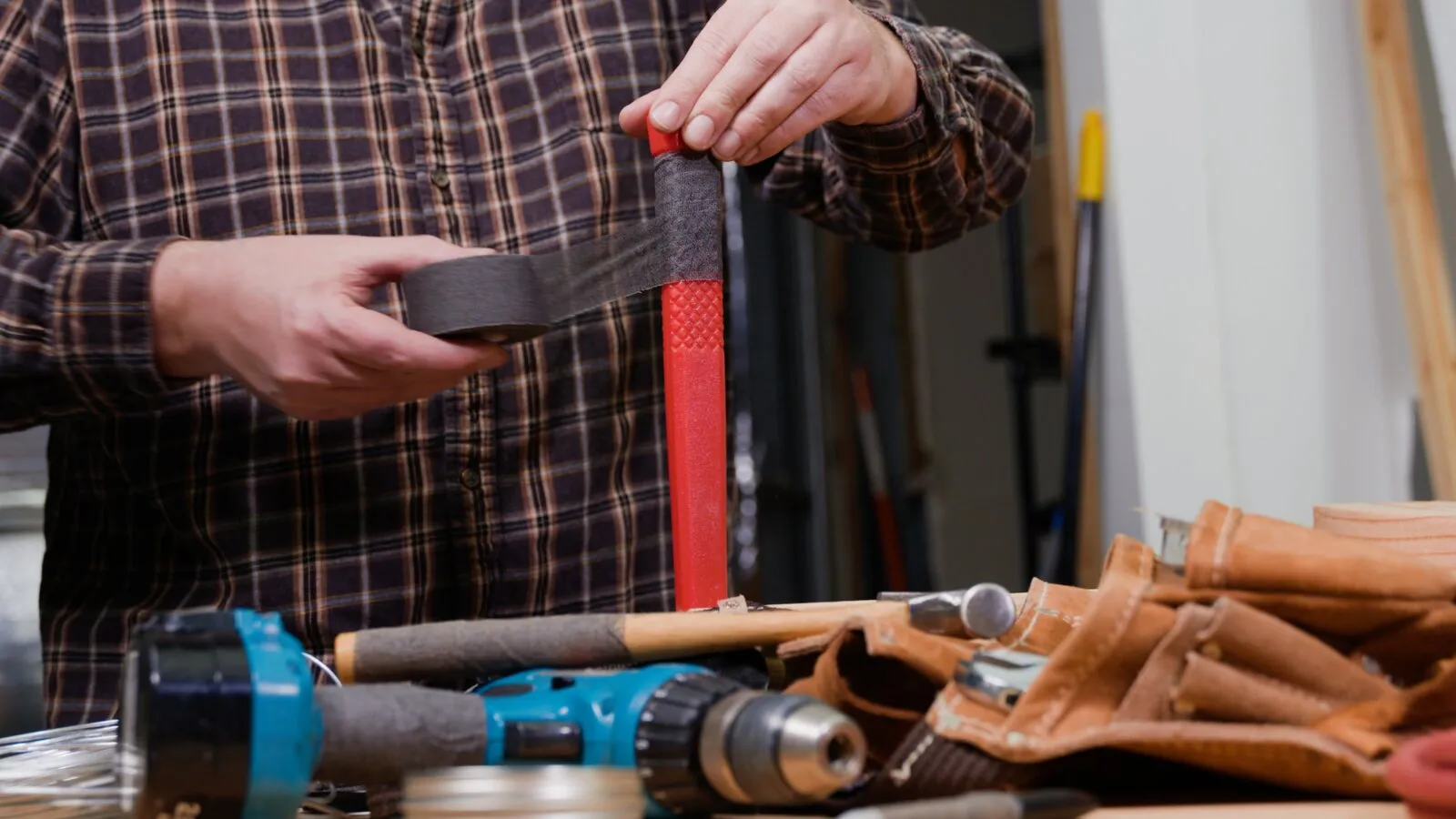
Worker's hands on factory floor with Guard-Tex wrapped fingers handling precision parts

Since 1935

Built for the shop floor. Never left it.

Guard-Tex was invented in 1935 specifically for factory workers who needed finger protection without gloves. Nine decades later, it's still doing the same job — because the physics of protecting hands during precision work hasn't changed.

Targeted Protection at Every Workstation

Guard-Tex is a self-adhering gauze tape — no adhesive touches skin or parts. It bonds only to itself through cohesive technology, wrapping two to three layers on the specific fingers and hand zones that take damage at each workstation. The deburring operator wraps different zones than the inspector. The parts handler wraps different zones than the assembler. Everyone gets protection calibrated to their actual damage pattern.

The woven cotton-gauze construction breathes through 8-hour shifts — no sweat buildup, no skin maceration, no dermatitis from trapped moisture. Workers who've given up on nitrile gloves because of sweat actually prefer Guard-Tex because their hands stay drier. And at end of shift, the tape removes instantly with zero skin tearing. No adhesive to rip. No residue to clean. Hands stay healthy day after day, shift after shift.

"We run eight Okuma lathes and forty employees. Hand injuries were our top OSHA recordable three years running. We put Guard-Tex at every machine and trained operators to wrap before each shift. Hand injuries dropped 80% in the first year. Our mod rate dropped a full point the year after."
— Shop Manager, precision CNC machining facility, Elk Grove Village, IL

For food processing facilities, blue Guard-Tex is detectable by metal detectors and high-contrast visual inspection — meeting HACCP requirements for foreign body detection. Same zero-adhesive technology, same breathable construction, with the added safety of detectability in your product stream.

$0.25
Per Worker Per Shift
80%
Injury Reduction
0
Adhesive on Parts
1935
Made in USA Since

Guard-Tex vs. Standard Industrial Hand Protection

Most facilities cycle through the same options — gloves, finger cots, adhesive bandages, then frustration. Here's the real comparison for workers who need both protection and dexterity:

Guard-TexCut-Resistant GlovesNitrile GlovesAdhesive Tape/Bandages
Dexterity Near-bare feelReducedModerateModerate
Targeted zones Wrap only damage areas Full hand Full handSingle spot
Survives full shift 8+ hoursTears/puncturesFalls off
Zero part contamination No adhesiveLint/fiber riskPowder risk Adhesive transfer
Breathable Gauze weaveVaries Traps sweatPartly
Painless removal No adhesive Tears skin
Worker complianceHigh — comfortableModerateLow — sweatyLow — falls off
Cost per shift~$0.25$1.50–5.00$0.15–0.50$0.50–1.00

How to Deploy Guard-Tex Across Your Floor

Implementation takes one shift. Here's the EHS manager's playbook:

1

Audit Your Injury Log

Pull your OSHA 300 log and workers' comp claims for the last 12 months. Filter for hand and finger injuries. Identify which workstations generate the most incidents and which hand zones — fingertips, knuckles, palms, webs — are getting damaged. This data tells you exactly where to start and how to measure ROI.

Pro tip: Track near-misses and first-aid-only incidents too. Recordables are the tip of the iceberg — the micro-abrasions that don't get reported are where Guard-Tex makes the biggest difference.
2

Map Wrap Zones by Workstation

At each high-injury station, have the operator identify the two to four finger and hand zones that take the most abuse during their specific tasks. A deburring operator wraps fingertips and the thumb pad. A parts inspector wraps the index fingertip and middle finger. A sheet-metal handler wraps the web and knuckle ridges. Each station gets a custom "wrap map" posted at the workstation.

Pro tip: Photograph each operator's hands at end of shift on day one. The redness and abrasion patterns become the wrap map.
3

Train the Two-Layer Wrap

The technique is simple enough to teach in two minutes. Start at the damage zone, wrap two overlapping layers of Guard-Tex, tear by hand. Two layers provides effective protection without sacrificing dexterity. For heavy-contact zones like deburring stations, three layers may be warranted. Workers should be able to wrap both hands in under 60 seconds.

4

Stock Rolls at Every Station

This is the compliance multiplier that most facilities miss. Put a roll of Guard-Tex at every workstation — not in a central supply closet. When tape is within arm's reach, workers rewrap and adjust throughout the shift. When it's a walk to the supply room, they work unprotected. One roll per station lasts weeks and costs less than a single pair of cut-resistant gloves.

Pro tip: Use blue Guard-Tex in food processing and white/beige elsewhere. Color-coding by department helps with inventory and compliance tracking.
Beige Guard-Tex roll and tin

Industrial Standard

Beige Guard-Tex — 3/4" × 30 yards

The same tape trusted by machinists, assemblers, and inspectors since 1935. One roll per worker per month. Bulk pricing available for facility-wide rollout.

Request Wholesale Pricing

What Manufacturing Professionals Are Saying

"We process 200,000 parts per day. Our assembly team handles sharp stampings all shift — fingertip cuts were our biggest first-aid issue. Guard-Tex at every station eliminated 90% of those incidents. The tape costs us less per month than one workers' comp claim costs in a single day."
— Tom H., EHS Manager, automotive stamping plant, Detroit, MI
"I run QC in a machine shop. I check surface finish on 300+ parts per shift — by touch. Gloves are not an option. Guard-Tex on my fingertips protects against burrs without killing the sensitivity I need. Should have had this my entire career."
— Maria L., Quality Inspector, precision machining, Cleveland, OH
"Food processing facility — we switched from adhesive bandages to blue Guard-Tex two years ago. No more adhesive bandages falling off into the product stream. No more skin tears from tape removal. Our HACCP auditor approved it on the spot."
— Robert S., Plant Manager, food processing, Green Bay, WI
"I manage 60 assemblers building electronic controls. Nitrile gloves were causing contact dermatitis in a third of the team. Switched to Guard-Tex finger wraps — dermatitis cleared up completely because the tape breathes and there's no latex or adhesive against the skin."
— Jennifer W., Assembly Supervisor, electronics manufacturer, Austin, TX

Across the Entire Operation

Guard-Tex works everywhere hands touch the work. The same tape that protects fingers on the machining floor also wraps tool handles for vibration damping, protects hands during gloveless precision work at inspection benches, and provides individual finger protection in packaging and shipping departments.

For workers who wash hands frequently — food processing, pharmaceutical, and clean-room environments — Guard-Tex also protects against hand-washing skin damage and sanitizer-related dermatitis. One product, deployed everywhere, solving the same fundamental problem: protecting hands without sacrificing the dexterity that makes good work possible.

Frequently Asked Questions

What tape do factory workers use on their fingers?

+

Many factory workers use Guard-Tex self-adhering tape — a woven gauze tape that bonds to itself without adhesive. It protects fingertips and hands from abrasion, cuts, and friction without reducing dexterity. Unlike adhesive tape, it removes clean after full shifts without tearing skin or leaving residue.

Does Guard-Tex survive a full 8-hour shift?

+

Yes. Guard-Tex is designed for industrial use. The cohesive bond holds through repetitive motion, material handling, oils, and coolant. Most workers get a full shift from one application. For high-wear tasks, a quick mid-shift rewrap at break keeps protection consistent.

Can Guard-Tex be used in food processing?

+

Yes. Blue Guard-Tex is detectable by food processing metal detectors and visual inspection. It contains no adhesive that could transfer to product, making it safe for food-contact environments where HACCP compliance matters.

Will Guard-Tex contaminate parts or products?

+

No. Guard-Tex contains zero adhesive — it bonds only to itself. It cannot transfer residue to machined parts, assembled components, or finished products. Safe for precision manufacturing, electronics assembly, clean rooms, and any environment where contamination is a concern.

How does Guard-Tex compare to cut-resistant gloves?

+

Cut-resistant gloves protect the entire hand but reduce dexterity. Workers often remove them for detail work, leaving hands unprotected. Guard-Tex wraps only the vulnerable zones while leaving the rest bare for full sensitivity. For workers who need tactile feedback, targeted wrapping outperforms full-hand gloves.

What does Guard-Tex cost per worker per shift?

+

Approximately $0.25. A single roll provides weeks of daily wrapping for one worker. Compared to the average $7,500 direct cost of a single hand injury — and $25,000+ in total costs — the ROI is measured in thousands of percent.

Shop

Get Guard-Tex

Protect Every Hand on Your Floor.

Wraps anything. Sticks to nothing. American made since 1935.

Request Wholesale Pricing